You've proven you can do the work.
Now build the positioning to move up.
A 12-week group coaching cohort for women in STEM with 15 to 30 years in: the ones carrying the hardest work, hearing "not quite ready," and watching people with less experience move up anyway.
Every week you walk away with a finished, usable career asset. Five of them by the end, plus an AI strategy partner that works between sessions.
Next cohort starts January 11, 2027. Early-bird rate for seats reserved by November 30.
Reserve My Seat →
Start with a quick fit check (5–7 min).
I ran 43 successful design reviews.
Someone else got the title.
Early in my run as chief engineer on a GPS satellite program, I was given the stretch assignment everyone said would prove I was ready: lead the design of the spacecraft bus. My team ran 43 successful Preliminary Design Reviews across three levels of hardware, six months ahead of schedule. The customer agreed the design was rock solid. By every measure that shows up on paper, I had earned the promotion.
I didn't get it.
So I did what ambitious women in STEM are told to do. I took the feedback. I found mentors. I over-delivered again: 43 more Critical Design Reviews, also ahead of schedule. Four promotion cycles later, nothing had changed. And then I learned the thing no one tells us: performance is required, but it is not sufficient. The person I thought was my sponsor wasn't advocating for me at all.
I'm Jennifer Wright. I spent 28 years at Lockheed Martin as a systems engineer, program manager, and chief engineer, and I've sat on both sides of the promotion table. What I eventually learned in those rooms is the strategy I now teach.
We've all done some version of this, right? Deliver more, wait, deliver more. And the feedback that comes back never has a spec you can build to:
- "You're not quite ready." Ready is being defined by their comfort, not your performance.
- "Keep doing what you're doing." They rely on you at this level. Promoting you creates a hole nobody wants to backfill.
- "We just need to see a bit more." More of what? If they can't name it, it isn't a development plan. It's a parking lot.
- "You're such a team player." Your work is being absorbed without your name on it.
Promotion feedback is rarely literal. It's political.
And the researchers have now measured what we lived: in a study of nearly 30,000 workers, women received higher performance ratings than men, and lower ratings on "potential," and that potential gap explained up to half the difference in promotion rates (Benson, Li & Shue, American Economic Review).
You don't have a performance problem. You have a positioning problem. And there's a difference between a coach who tells you that and a program that hands you the tooling to do something about it.
Most women I work with are living one of three patterns.
Sometimes more than one. Once you can name yours, you can stop playing it.
The Overlooked Expert
You're doing high-level technical work, but nobody in the rooms where advancement gets decided can explain your impact in a single sentence. Your contributions are real, significant, and invisible at exactly the level that matters.
The Scope Sponge
You absorb the work that keeps everything running. And because you're so good at absorbing it, leadership keeps you exactly where you are. They can't afford to promote you, because they can't afford to lose what you're holding together. Heaven help you, should you be efficient at it.
The Quiet Fixer
You solve critical problems without fanfare and assume the work will speak for itself. It won't. When decisions come around, they choose the person whose impact travels in one clean sentence, not the person quietly keeping the program alive.
These aren't personality flaws. They're patterns baked into a system that rewards visibility over value. There's nothing wrong with you. What's missing is a strategy.
If you've tried everything and it hasn't worked, there's a reason.

You operated as an optimizer instead of an architect.
The meritocracy promise says deliver and someone will notice. In most organizations performance is the price of admission, and the differentiator is how your impact gets translated, who carries it into the right rooms, and whether the people with influence understand what you're ready for. Optimizers work harder. Architects redesign their position in the system.

You collected credentials instead of political capital.
Every "not ready" sent you off for another degree, another certification, another stretch assignment. But advancement is a decision process run by humans evaluating perceived risk, and credentials barely move that needle. I got a corporate "MBA" and several levels of program management training. It never promoted me, and it never promoted the other women at my site either.

You were handed mentors when you needed sponsors.
Mentors advise you. Sponsors spend their own political capital to move your name in rooms you're not in. Only 23% of employees have a sponsor (Gallup), and women are chronically over-mentored and under-sponsored. "Get a mentor" is a stall tactic dressed up as investment.
None of this is your fault. These are the strategies the system teaches. The Accelerator replaces them with strategies that match how advancement actually works.
Every week ends with something you can use. By week 12, you own five assets.
This is a build program: six live 90-minute trainings, six live 60-minute Q&A and hot seat calls, two written portfolio reviews from me, and structured templates for everything. Here's what you walk away holding:
1. The Bias Pattern Detector
Installed in week 1, before the first live training. The five repeatable bias patterns that run promotion systems, the masking language for each ("she's doing great, but..."), and the calibration-room decodes, so you stop internalizing "not quite ready" and start seeing the mechanism behind it. You'll use this one for the rest of your career.
2. The Promotion Strategy Portfolio
The running asset of the whole program. It starts as your validated target role and power map, and upgrades six times: proof inventory, 3 to 5 proof stories in context-constraint-decision-outcome-metric format, your one-sentence value proposition, and the full evidence base (your Career Self-Inventory) that holds up in promotion discussions and shuts down imposter syndrome with documentation instead of affirmations. I personally review it twice, in writing.
3. Executive Talk Tracks and the 30-Second Carry
Your 15-second value statement, 60-second proof story, and 2-minute promotion narrative, plus scripts for the four conversations that move advancement: manager alignment, the sponsor ask, scope expansion, and the promotion conversation itself. The 30-Second Carry is the version a sponsor can repeat, accurately, in a room you're not in. That's the one that gets you chosen.
4. Your Career Board of Directors, activated
The concept that changes everything. Three core seats that carry your name into rooms you're not in (Sponsor, Champion, Mentor), plus the elective seats your situation calls for (Connector, Strategist, Technical Sage, Peer Mirror), mapped to real names from your own power map, with clean asks drafted and at least one outreach sent before the program ends. Built, not inherited. This is how your name starts coming up before decisions get made.
5. The 90-Day Gap-Closure Plan
The 2 to 4 gaps that would actually change the decision about you, evidence of closure defined for each, weekly proof outputs, and feedback checkpoints so the closing is visible. It comes with the Glue Renegotiation Script: the three-move conversation for shedding absorbed, non-promotable scope without reading as abandonment, which is how you free the hours to run the plan.

Included: The Architect, your AI strategy partner between sessions.
The promotion system is being rewritten again right now, this time by AI, and once again without input from the women it already overlooked. I'd rather put the tool on your side of the table.
Every member gets The Architect: a 24/7 AI strategist trained on the complete V.A.L.U.E.D. method and seeded with your own Promotion Readiness Scorecard profile.
It's there at 9pm the night before the conversation, when the cohort call is three days away.
- Paste in vague feedback and decode it.
- Pressure-test a proof story.
- Rewrite a talk track.
- Draft a clean ask for a specific board seat.
Generic AI tools can format a brag document. The Architect knows your target role, your proof themes, and your board, and it coaches inside the same system we build together on the live calls. It's included in your seat.
The Architect runs inside your own Claude account, so your career details stay in a workspace you control. A Claude Pro subscription (about $20 a month, paid to Anthropic) is a prerequisite; setup is covered in your intake call.
The method behind the Accelerator
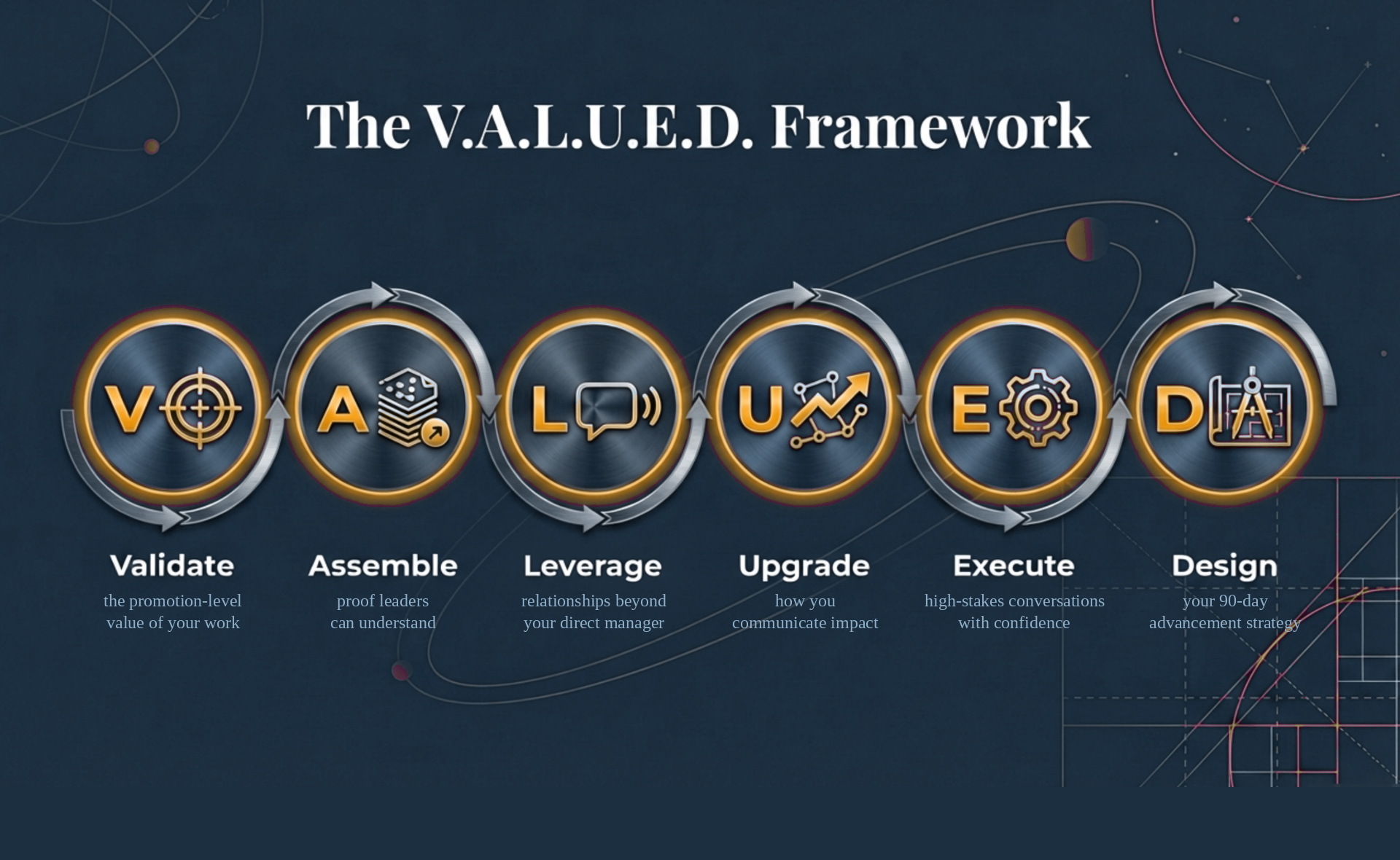
The Accelerator runs on my V.A.L.U.E.D. system: six steps that take you from seeing the system clearly to a designed role with active sponsorship behind it. Validate the target. Assemble the proof. Leverage it into decision-maker language. Upgrade your support system into a Career Board of Directors. Execute the 90-day plan. Design the role.
Built for the senior end of the field.
This is for women in engineering, data science, aerospace, IT, and the rest of STEM with roughly 15 to 30 years of experience: senior ICs, managers, and directors who are already delivering promotion-level work. If you're early-career or looking for generic confidence coaching, this isn't your program, and I'd rather tell you that now.
It works whether your next move is a title, expanded scope, or a role that doesn't exist yet and needs to be designed. And it acknowledges the whole person. You have kids, or aging parents, or both, and a life where your career isn't the most important thing but influences everything. The program is built for that reality: one live call most weeks, assets built in-session, everything recorded.
Women I've coached come from across the STEM industry, including:


I've been the woman doing the work. And I've been the leader deciding who advances.
I spent 28 years at Lockheed Martin leading mission-critical work across GPS satellite programs, Space Force contracts, and multi-billion-dollar human spaceflight proposals for NASA. Systems engineer, program manager, chief engineer. I was the first woman to receive the American Astronautical Society's Industrial Leadership Award in the award's first 30 years, honored alongside former aerospace and defense CEOs. I've sat in the calibration rooms. I know exactly how promotion decisions get made, and why strong performers get overlooked.
And I know why you haven't found help that fits. The coaches who understand promotion have never done your job. The coaches who've done your job mostly teach you how to leave it. A senior woman engineer doesn't need surface-level help, and she shouldn't have to choose between someone who gets the system and someone who gets her field. That's why I built this.
28 Years
Inside the same system you're navigating
First Woman
Recipient of the AAS Industrial Leadership Award in its 30-year history, honored alongside CEOs of Lockheed Martin and SpaceX.
Mission-Critical
Experience across GPS, DoD, and NASA
1,000+
Women coached across STEM disciplines
What I will never promise you
Some programs in this space advertise a promotion inside 90 days. I spent 28 years watching how corporate promotion systems actually move, and I honestly don't know how anyone makes that promise ethically. Calibration cycles, budget windows, and reorgs don't run on a coach's timeline, and a guarantee that ignores the system is just the meritocracy myth wearing a sales page.
So here's what I can promise instead. Picture the version of this that's actually within reach. You walk into your next review holding a portfolio your VP can scan in 60 seconds. Someone on your board says your name in a calibration room, and you hear about it afterward. Vague feedback stops landing as a verdict, because you can decode it on the spot and answer with a clean ask. The imposter-syndrome spiral runs into a documented evidence base and loses.
You may have thought you needed more training, more mentors, one more credential. Your career was always in your hands. This program shows you what that means and gives you the plan.

Getting started is the simple part.



1. Take the fit check
Five to seven minutes. It tells us both whether this program matches your situation.
2. Book your enrollment call
We'll find your biggest positioning gap and decide together whether the Accelerator is the fastest path. If it isn't, I'll say so and point you somewhere better.
3. Start building January 11
Week 1 installs the Bias Pattern Detector before the first live training. You'll have your first usable asset before we ever meet on a call.
Stop hoping your work will speak for itself.
Build the proof and positioning that make leaders pay attention.
Complete the fit check, then book your call.
On the call, we'll identify your biggest positioning gap and the fastest path forward - whether that's inside the Accelerator or not.
What happens if nothing changes
Another cycle of "keep doing what you're doing." The scope keeps growing while the job description stays put. You keep training the colleagues who get promoted past you, because they have cleaner narratives and louder advocates. And the 11pm question, "is it me?", keeps getting harder to shake, when the honest answer is that you've been running an experiment with no control group and the system holding the variables.
That cycle doesn't break on its own. It breaks when the strategy changes.
Join the January 2027 Cohort
The cohort is deliberately small, so every woman gets direct feedback on her actual situation, written portfolio reviews from me, and a hot seat whenever she needs one.
These strategies have helped women in STEM land new roles, negotiate promotions, and secure more than $2M in raises.
This is for women in STEM who are already delivering strong work and need stronger positioning, proof, and sponsorship. It is not for someone looking for generic confidence coaching.
This is an investment in how your value gets seen, discussed, and rewarded.
STEM Leadership Accelerator: January 2027 Cohort
$2,997
Early-bird: $2,497 when you reserve your seat with a $250 deposit by November 30. Your deposit counts toward tuition.
Cohort starts January 11, 2027 · Early-bird deadline November 30
- 12 weeks of live group coaching with Jennifer
- The full V.A.L.U.E.D. system
- 6 live 90-minute trainings
- 6 live 60-minute Q&A/hot seat calls
- 2 written Promotion Strategy Portfolio reviews
- The five walk-away assets, with structured templates for each
- The Architect: your AI strategy partner between sessions, trained on V.A.L.U.E.D.
- All session recordings in your course library
The 14-Day Fit Guarantee
Try the first training and the first hot seat call. If it's not what you expected, email within 14 days for a full refund.
The bigger risk is spending another year doing promotion-level work with entry-level positioning.
"Everything you said explains the last decade."
— Masterclass Attendee, Aerospace Industry
Questions worth asking
Will this actually get me promoted? Is there a guarantee?
Is this for my level?
I don't have time.
What happens after the 12 weeks? How long do I keep access?
What if I can't attend live?
Can my employer pay for this?
What if I decide to leave my company instead?
Can't I figure this out myself?
You were never the problem.
You do not need to become someone else to advance. You need proof leaders can trust, language they can repeat, an AI-era toolkit on your side of the table, and advocates who will say your name in rooms you're not in. You're not missing a credential, or a degree, or "executive presence." What's been missing is a strategy and a plan, and that's exactly what we build.
I'd love to work with you on creating the strategy that gets you the visibility, the sponsorship, and the advancement you've already earned.
Next cohort starts January 11, 2027. Early-bird rate for seats reserved by November 30.
Reserve My Seat →